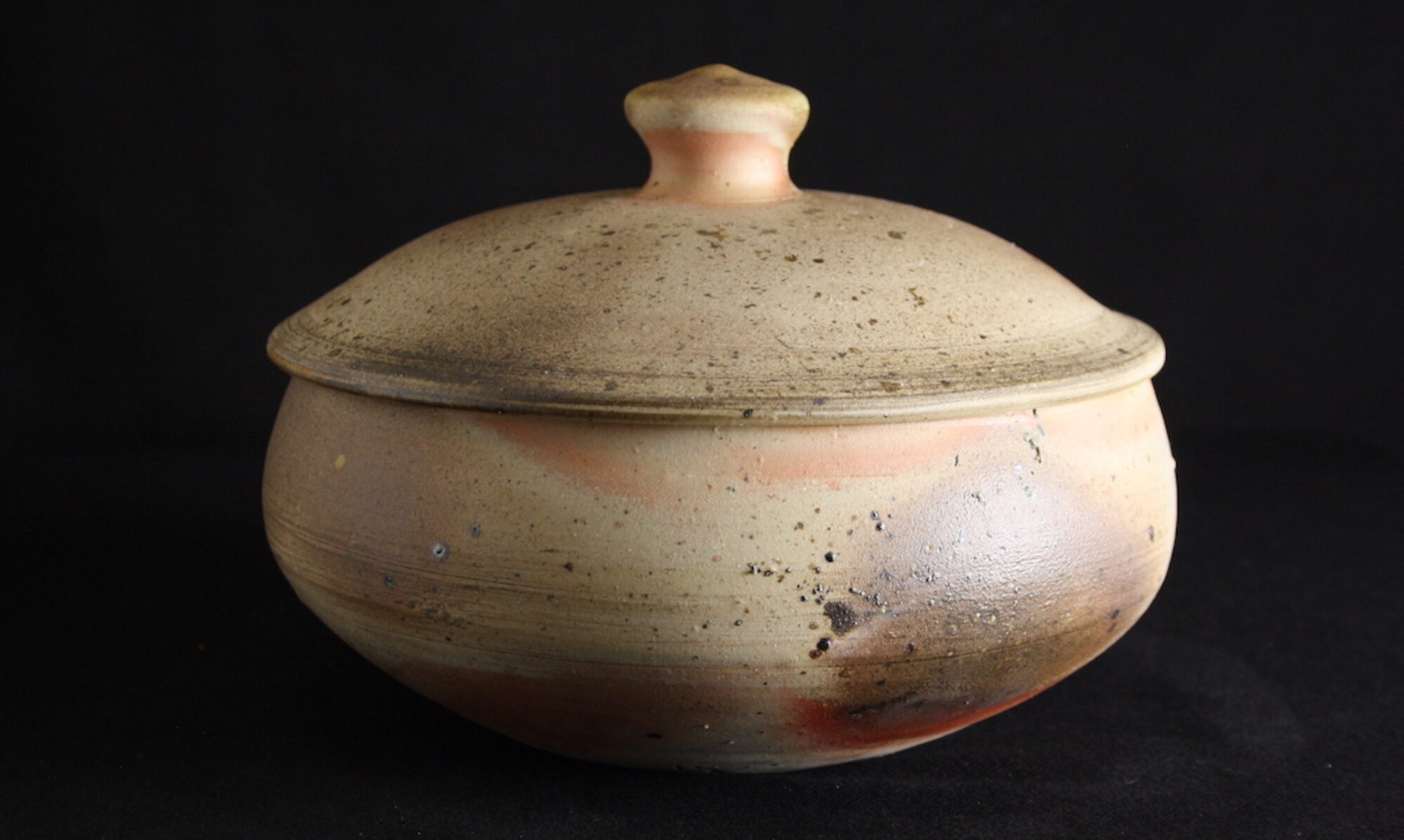


Forty seven years on from first working with clay, I remain fascinated by its plastic nature, its transformation into ceramic by heat and, particularly, by the effects that can be achieved in a wood-fired kiln. What started as a therapeutic antidote to academic research, and the challenge of learning to throw on a potter’s wheel, remains a crucial part of seeking a balance between head, heart and hands.
Throwing turned out to be just the start of an ongoing process of exploring this exacting and technical craft. I now have a large, ‘anagama’ style wood-fired kiln that I currently fire just once a year. The slow production cycle and unpredictable results require a level of detachment from any concern with efficiency, productivity or tight control. A lot can, and does, go wrong but it is often the accidents, happy or otherwise, that lead to new avenues to explore.
It is mostly left to the flames, licking, flashing and depositing fly ash during the three-day firing, to leave their mark and decorate the pot surfaces. Around one day into the firing, when the temperature reaches about 1000 oC, the firebox is deliberately stoked with an excess of wood so that the chimney is unable to pull in sufficient air for full and clean combustion. As far as possible, we maintain this ‘reducing’ atmosphere as the temperature climbs slowly to around 1340 oC over the next day and a half. The oxygen starved atmosphere created through the kiln each time the firebox is stoked strips oxygen molecules from the clay body and any glazes used, altering metallic oxide colours and the surface characteristics so at to create a rich palette of red through purple, orange and browns in the clay. Meanwhile, carbon trapping gives greys and black and the ash flying through the kiln melts and fuses with the clay to to form a glaze where deposits are heaviest.
 How best to stack the pots in the kiln, the firing schedule and the composition of the clay body are subject to ongoing (albeit slow) experimentation. To prevent the pots from fusing together with melted ash, the pots must all be separated from the kiln shelves, and from each other, with refractory wadding (made from fireclay, sand and sawdust) or with seashells. Stacking the kiln is a slow process, a three dimensional puzzle to make best use of the space in the kiln whilst leaving suitable paths for the flames to find a way through all parts, top, bottom, left and right, from the firebox through to the exit flue and chimney. Many pots are fired on their side. Bowls are often fired upside down, stacked on top of each other, to encourage the flames to lick across and flash the inside surfaces. Simple wood-ash or shino glazes are sometimes also used particularly on inside surfaces.
 My current kiln was built in 2010 and is fired for three days and two nights with the support of an enthusiastic team of helpers. The top temperature of around 1340 oC is reached on the second day and is held for around 24 hours before the kiln is cooled and sealed. The pots can be unloaded, cleaned and sorted a week or so later.